Spinning Success
(Please note: No client names are mentioned due to confidentiality reasons.)
Introduction
A Switzerland-based supplier of systems for manufacturing yarn from staple fibres (the world’s leading supplier then), had taken up the task of redefining its business strategy in 2024. They aimed to bring significant results by 2027.
The company had recently undergone a major organisational shift, granting its India team the decision-making authority for its own P&L. The purpose behind this strategic decentralization aimed to power autonomy in the system and added innovation.
However, it also revealed challenges in goal setting, leadership alignment, mindset shifts, and strategic execution.
With great power, comes great responsibility
The newfound autonomy that the India team experienced also brought dual challenges of delivering financial operations while simultaneously nurturing a culture of accountability and collaboration.
To further elaborate on the key challenges faced, they included:
Defining goals for themselves as independent units.
A lingering reliance on external decision-makers from Switzerland.
The need to balance sales in the domestic and export markets.
Achieve alignment on the newly implemented MBO structure.
Building trust and cohesion with a recently restructured leadership team.
Preparing for a challenging business environment while focusing on innovation, customer-centricity, and localisation.
The majority of the work focused on developing the ‘human’ skills and strategic aspects of the company, annoyingly, this is often referred to by the external world as soft skills.
The nature of these challenges was critical in ensuring the company’s success as a self-reliant entity. Overcoming them would have led them to achieve their vision of becoming a technological leader and a culture where people would flourish.
Now comes in ARC
Recognising the urgency of the situation, the given company partnered with ARC for a 3-Day Workshop on Strategy. The intervention was customised to address the strategic and cultural dimensions of their objectives.
All of this was done, while ensuring that the Leadership Team was aligned and equipped to execute the organisational vision.
The aim of the workshop:
To build a cohesive Leadership team while nurturing a shared understanding of the company’s strategic priorities and setting objectives.
To get into the details, the key activities were designed to:
Define measurable goals aligned with the Global Business Vision.
Design a goal cascading plan.
Diagnose and address team dysfunctions, focusing on trust, accountability, and open communication.
Promote a culture of proactive decision-making and ownership.
Enhance cross-departmental collaboration to break silos and leverage collective expertise.
The Key Facilitation methodologies for the intervention included different blends of our work:
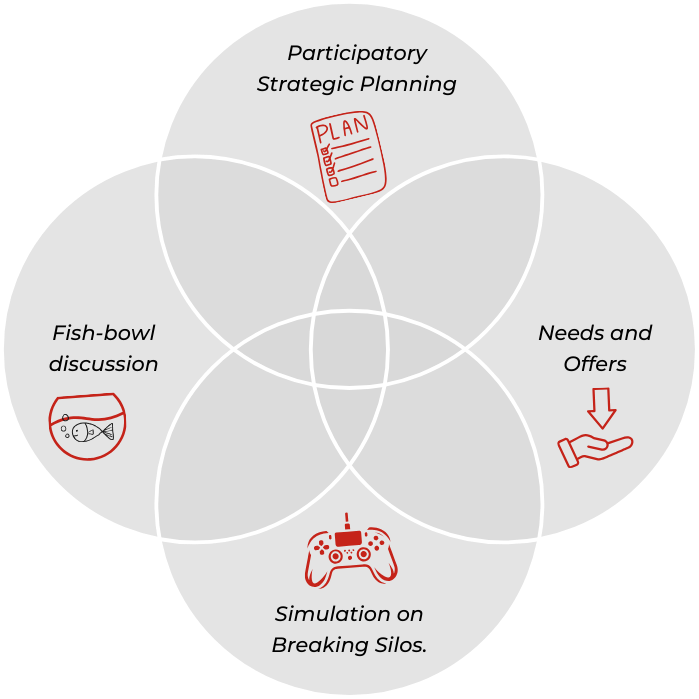
Our work in the entire process was to tap into the collective intelligence of the group as consultants and facilitate the energy in the right direction.
Further reading:
Are you Harnessing the collective intelligence of your people?
Here is an overview of the 2 clusters.
Step 1
Strategic Clusters with Qualitative Organisation Objectives
Financial Performance
Achieve X Cr. turnover with Y% EBIT.
Reduce warranty costs by B% compared to 2024.
Attain an A% market share.
Operational Excellence
Align factory utilization with capacity.
Achieve Z% market share in DivA sales.
Enhance order fulfillment with 100% on-time delivery (OTD).
Innovation
Automate repetitive tasks and develop next-generation machines.
Localise high-value DivA spare parts.
Customer-Centricity
Achieve Customer NPS of 9.
Deliver reliable, high-quality products and services.
People Development
Operate with H% female leadership.
Obtain GPTW (Great Place to Work) certification.
Localisation
Manufacture all spinning and winding machines in India.
Localize G% of machines.
Reliability and Excellence
Establish the team as a global talent hub.
Maintain technological leadership as a preferred system supplier.
The needs and offers facilitation helped the teams to identify interdependencies across departments. They took the collaborative approach to leverage the strengths within the organisation by aligning efforts. Strategic priorities were made clear and the gaps were addressed.
The next step was to roll out the objectives at an organisation level in the coming 3 weeks.
Step 2
Implementing Management by Objectives
Individual objectives were set in alignment with the above Strategic Clusters.
Team-wise action plans were created.
Team leaders monitored progress a regular intervals.
Employees’ performance on the strategic initiatives was evaluated and rewarded.
The Impact post the Intervention
The leadership team met every six months to review progress at an organisational level.
Over the first year, the client we partnered with reported an additional benefit of 5 Crores for the organisation.
Remarkably the organisation achieved approximately 90% of the objectives they had set for the year. The milestone demonstrated the success of an intervention in aligning leadership, nurturing accountability and driving measurable results.
The partnered client positioned itself as a self-reliant, innovative and customer-focused entity, ready to achieve its ambitious long-term goals.
This is what Integrated strategic planning and cultural transformation look like in action and there is always more than what meets the eye :)