⛺️The Breakdown of 'Strategic Thinking.'
[Founder's Note: While I haven't formally learnt the art and science of 'Strategy', over the years I've gained a knack for it by facilitating workshops, applying it for our clients and of course, living it for ARC. Consider this edition as a heartfelt note from me to you on the lines of building a strategic mindset.
Originally published for ARC's Leadership Campfire on 6th March 2025.
Also, if you have the time, please fill out this short feedback form to let us know how we're doing. Link here.
— Adi Raheja
What is your calling towards strategy?
I facilitate strategy workshops because I have been doing it for years and genuinely enjoy the practice. Over time my aptitude for strategic thinking has been recognised, though I wasn't aware of this until these last few years.
Thinking strategically has become a practice that has been honed by implementing it in ARC and as part of our consulting work with clients.
What draws me to strategy are a few things:
The process of forward-thinking
Understanding the constants and variables
Identifying the levers that create maximum impact
Discovering moves that have the ability to turn tables in difficult situations.
Once you identify your calling, then you can own that quality within yourself and work on getting better at it.
What does strategy look like in action?
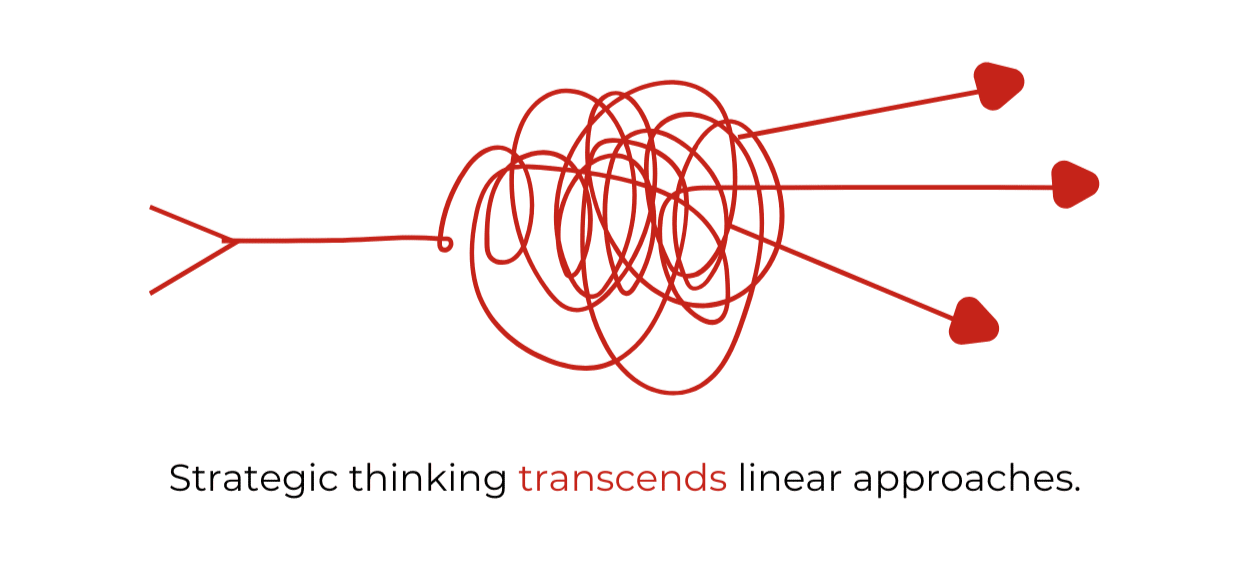
When an organisation struggles with sales, a linear solution might simply be to hire more salespeople. However, a true strategic approach can be something very different—perhaps developing a new product or finding a lever that creates exponential impact.
What's fascinating about strategic actions is that they often don't have a direct causal relationship to the problem. The strategic solution almost looks like something very different from the problem itself, but it creates a multi-fold impact.
What is that lever in your system that can give you a multi-fold impact?
The intention behind our workshops is to create value, share learnings, and, in the process, further develop our understanding through other people's experiences. I believe there is a genuine need for this work.
"There is always more than what meets the eye."
Many people use the word "strategy" very loosely, often confusing it with simple planning. Frequently, they label any linear action as strategy, even when it doesn't shift trajectories.
Organisations need to do better --to do exponentially better--and leaders need to understand how to create turnarounds in challenging situations.
Is your strategy married to a certain way of thinking?
Is your strategy married to a certain way of thinking?
What I enjoy most about strategic frameworks is that they typically come as models that help rearrange data beyond usual analysis. I'm particularly interested in these frameworks and in using multiple models to approach problems.
Here are some frameworks and models often used to classify information to evoke strategic thinking:
Scenario planning
Balanced scorecard
Force Field Analysis
BCG Matrix
Impact vs Effort matrix
Read more about them in this article.
The entire concept of a strategic lever fascinates me—how levers have the potential to create massive changes through chain reactions, like a strategic domino effect.
Do I have a favourite framework? That's a criminal question, it's like asking a doctor their favourite medicine. The moment you have a favourite, your mind starts narrowing the way you look at things- leading to a bias.
"Cognitive biases: The tinted glasses you didn't know you were wearing."
Instead, I practice brainstorming using various frameworks, then employ the impact-effort matrix to identify leverage points and determine which actions have the highest potential impact.
What role does your intuition play in strategy?
The application of strategy has evolved from winning geographical battles to organisational challenges that businesses face daily. However, this skill isn't reserved only for CEOs and executives—anyone in an organisation can devise and implement strategy.
The primary difference is that leaders typically have more authority to execute decisions, while those at middle and junior levels often need to influence and convince their bosses of seemingly illogical ideas that could create significant impact.
When was the last time you stopped yourself from thinking strategically because you felt you didn't have the authority to?
I'd also like to highlight the relationship between strategy and intuition. Often, a person with strategic skills doesn't realize they're using it until later, when they surprise everyone, including themselves.
But looking closely, intuition actually breaks into strategy. There might not have been a presentation or extensive document, but the insight came from somewhere meaningful.
By studying these moments where strategy was deployed, with or without awareness, we can identify common factors and introduce people to that kind of thinking. At the same time, providing them with tools they can access when needed.
Lastly, strategic thinking involves reflecting on questions that evoke something in you.
A starting point can be all the headings of this post. So, scroll back up again :)