⛺️ How to Navigate Difficult Conversations with Radical Candour?
Founder's Note: In a flashback scene from Suits, Jessica Pearson tells a young Harvey Specter, “If you’re going to work for me, you’ll have to face difficult conversations.” At the time, Harvey was avoiding a hard conversation with his brother Marcus about a restaurant venture that was clearly going to fail.
While the line comes from a dramatic TV show, it stands true in our work as leaders. When emotions and stakes are high, we often avoid the conversations that matter most. That’s where a framework like Radical Candour becomes useful to convey the truth better.
This was originally published for ARC's Leadership Campfire on 6th February 2025.
We want to make our content better, so if you have the time, please fill out this short feedback form to let us know how we're doing. Link here.
— Adi Raheja
One Thing to Learn
Any conversation that makes you feel uneasy or nervous is often the one that needs to happen. It is like an indicator of an important conversation.
Sometimes, when fear does not subside, one must choose to do it afraid.
Think of these conversations like fruit that's been left out for too long. They turn sour, leaving a bad taste for everyone involved.
When left unresolved, these conversations breed tension and worsen over time. As leaders, the issues we ignore today only grow larger tomorrow.
Difficult conversations aren’t just about conflict. They include high-value discussions such as:
Giving negative feedback
Addressing unprofessional behaviour
Handling workplace conflict
Discussing pay raise or promotion denial
Informing about layoffs or job termination
Addressing unmet expectations in a team
Confronting ethical issues or policy violations
Addressing resistance to change
Handling personal issues affecting work performance
Navigating a lot of these conversations might come naturally to you as leaders, but sometimes you may also miss seeing the impact that conversation can have on the other person. But don’t worry, you aren't alone.
While our research team was doing some digging, they came across a stat:
Over 80% of workers have never received training on managing difficult conversations, leaving them ill-equipped to handle such situations effectively. (Source: https://www.market-inspector.co.uk/communication-in-the-workplace)
But here’s a framework that can help.
One Thing to Apply
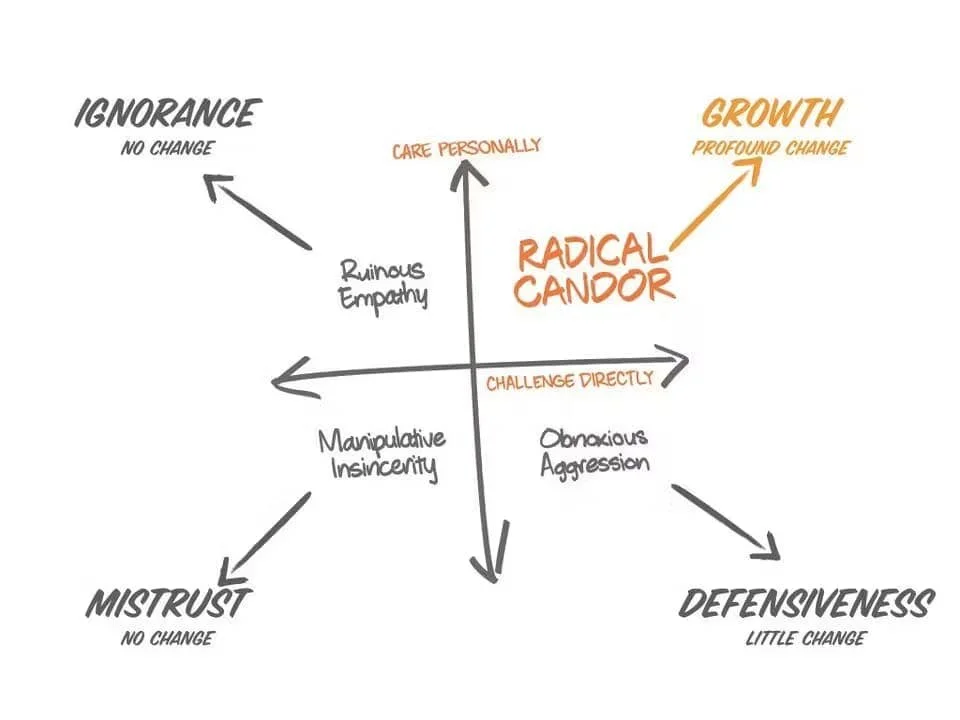
Radical Candor is a communication framework developed by Kim Scott that emphasises
→ Caring personally: Showing genuine concern for the other person.
→ Challenging directly: Being honest and direct about the issue.
The balance in this approach can make conversations more effective. Let’s dive deeper into it.
The Impact of it in the workplace.
Ruinous Empathy (Cares Personally but Avoids Direct Challenge)
Avoids difficult conversations to spare feelings, leading to unaddressed issues. Example: A manager hesitates to correct poor performance to avoid upsetting an employee.
Impact on the workplace? Problems persist, performance declines, and resentment builds when issues go unaddressed.
Radical Candor (Cares Personally and Challenges Directly)
Encourages honest, empathetic discussions where feedback is clear and supportive. Example: A leader gives direct but compassionate feedback to help an employee improve.
Impact on the workplace? Fosters trust, accountability, and open communication, leading to a growth-oriented culture.
Manipulative Insincerity (Neither Cares Personally nor Challenges Directly)
Avoids honesty for personal gain or to maintain superficial harmony. Example: A manager pretends to support an employee but secretly undermines them.
Impact on the workplace? Creates a toxic environment where employees feel deceived, lowering trust and engagement.
Obnoxious Aggression (Challenges Directly but Does Not Care Personally)
Gives harsh, blunt feedback without considering the recipient’s feelings. Example: A leader openly criticises an employee’s work without offering guidance for improvement.
Impact on the workplace? Causes fear, defensiveness, and resentment, reducing collaboration and morale.
Now, let’s make this more practical.
Here are four ways to use Radical Candour in your Leadership Journey.
1) Providing Constructive Feedback
Difficult conversations often arise when addressing poor performance or behavioural concerns. The conversation can be made specific with actionable feedback while maintaining respect.
Example: Instead of saying, “You’re not meeting expectations,” a leader might say, “Your recent reports have had errors that slow down the team. Let’s work on a strategy to improve accuracy.”
2) Reducing Avoidance of Tough Discussions
Fear of conflict is something that stops us from having these conversations. Radical candour normalises direct yet caring communication, making it easier to address sensitive issues before they escalate.
3) Encouraging Open and Trust-Based Communication
When leaders practice Radical Candor consistently, employees feel safe to voice concerns and accept feedback without fear of judgment.
Example: A team member struggling with workload can openly discuss challenges without feeling defensive.
4) Balancing Empathy with Accountability
Radical Candor ensures that difficult conversations do not come across as harsh criticism or passive avoidance but instead promote accountability and support.
Example: Instead of saying, “You need to work harder,” a manager using Radical Candor might say, “I know you have a lot on your plate. How can we adjust priorities to help you succeed?”
Final thought: Why this matters
The best leaders don’t shy away from difficult conversations- they embrace it. The next time you find yourself hesitating, remember: A tough conversation today prevents a tougher situation tomorrow.
What’s one conversation you’ve been avoiding?
This is your sign to have it.
Lead with courage.
Tell us how we are doing, give us feedback here.