
Introduction

Standard PPT decks. Rehearsed sessions. Agreed on workshops that were scheduled just the night before. It worked flawlessly. This system worked for ARC until the client stakeholders weren't concerned about the business impact our created. But the fact was that not all behavioural problems could be solved through a standardised deck and rehearsed sessions. With time, reliability was bound to drop.
It worked for ARC until we realised that to do more meaningful work, to create a change in people and thereby in the organisation, it would take something different.
The transition
Slowly, the transition took place from being a 'Training Company' to a Consulting firm in the space of Organisation and Leadership Development. And through that transition, the Research Function was born.
To understand what the research function does, one needs to understand how ARC functions.
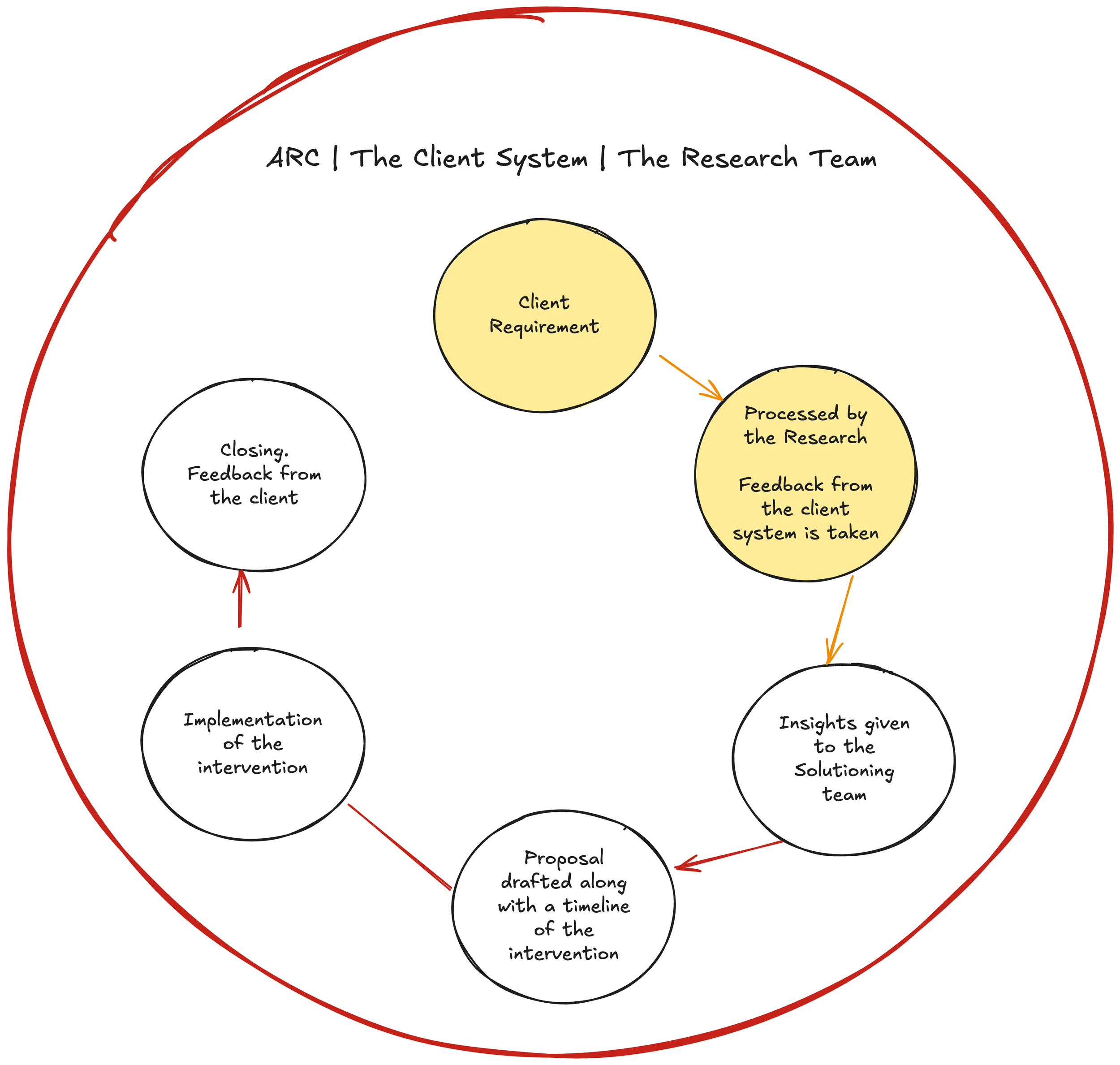
The research function became the team that wore swimsuits, oxygen tank on the back, helmet on the head ready to dive deep into a client's system to gauge the problem statement. Through FGDs, Surveys, in-depth interviews, data analysis means they processed large amount; sometimes verbatim of over 100 people would be processed in a neat document for the solutioning team to process into a proposal.
And those little tid bits of information then create that 'Aha!' moment for the client. Things that they hadn't even thought of, get uncovered in the process.
As a function research has always been a custodian of sensitive information. Evocative questions like what's working well and what's not working well are asked in FGDs. Through proper context and rapport, people trust the function. They open up.
We do this 'and also' that philosophy
With time, the research function followed the... we do this 'and' that philosophy. As they ground themselves, they discovered more. Often times they had to choose 'either or' but if research as a function can't balance two polarities, then how could they expect someone else to do it.
Hence, we decided to balance the 'Thinking' and 'Doing', 'The Science and the Art'.
Then it emerged.
Why not use 'And also' over 'or'?
Their next 'and also' was presenting their work to the world.
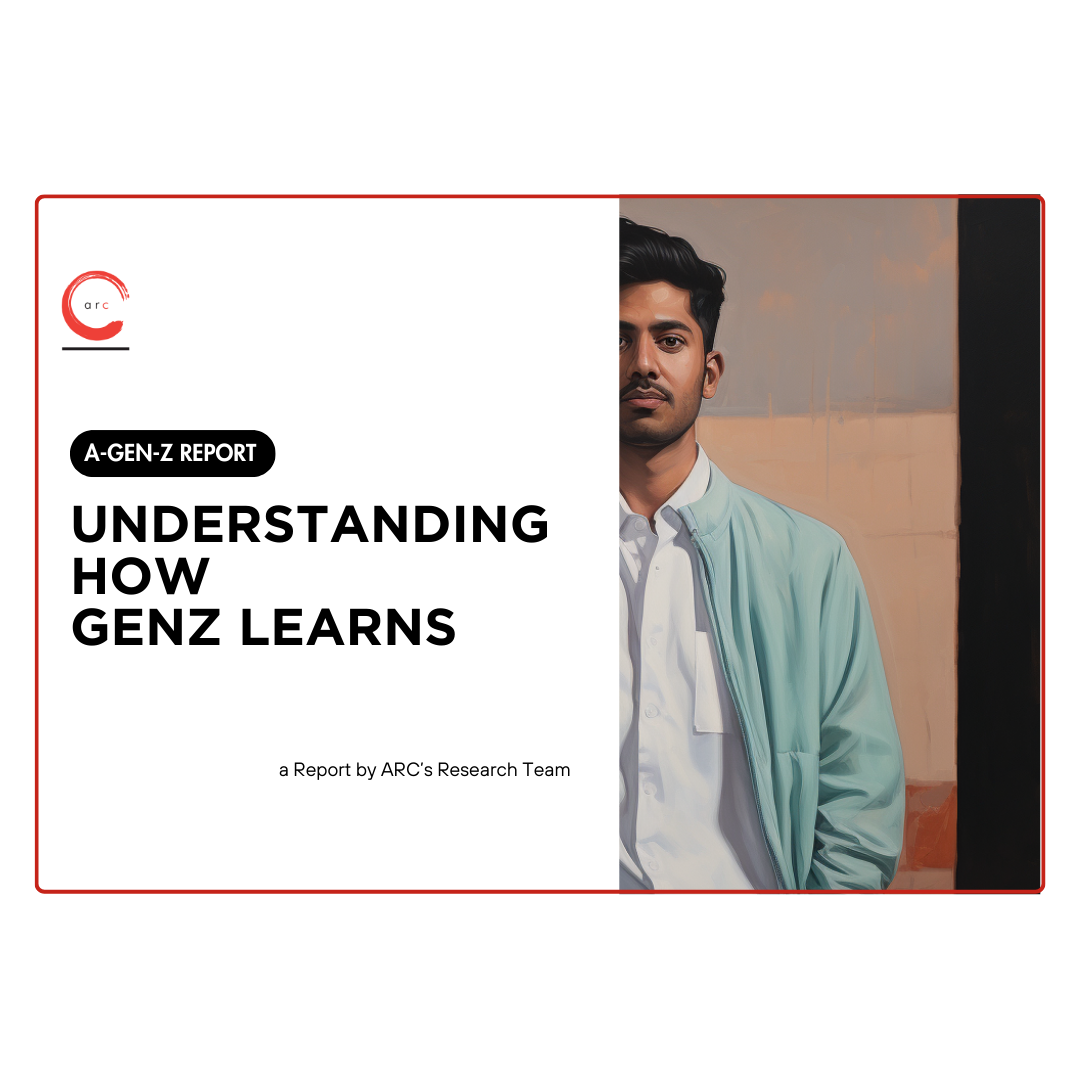
Research project: Understanding How Gen Z Learns
(Published in the International Journal of Learning and Development)
How do we work with GenZ? A major theme in so many client requirements. If you feel the same pinch in your leadership, this report is for you. It attempts to figure out how Gen Z learns.
Concept Paper: Completeness of Sublimation
What happens when you feel intensely angry at your boss, but the expression of it is considered unacceptable in contexts like the workplace? The paper talks about a better way to maintain emotional well-being through the Completeness of Sublimation.
(Presented in SYMPSYCH 2025)
while also being of support to ARC's core work through
-
![]()
Organisation Diagnostic Assessments
(A customisable assessment based on the client context)
Every organisation is unique, just like a living being. Hence, in an OD intervention, the existing structure is first studied to evaluate all its parts. Through ODA we understand all parts of the system (both visible and invisible). This further informs intervention design.
-
![]()
Manager Review Form | Self Review Form (MRF SRF)
(A holistic feedback capturing mechanism)
In any development journey, feedback is an important aspect. Manager and Self Review Form is one way that feedback is used as lever to create development journeys and plan.
Through MRF and SRF, different competencies are tapped in to understand alignment between manager and individual. With this process action-perception gap is evaluated.
-
![]()
The Learner Preference Survey
(A survey to infer a group's learning style)
Does the group prefer experiences or sit-down videos? Do they prefer learning in a group or individually? Do they wait for specific instructions or instantly start engaging?
Adapted from Kolb's cycle of experiential learning. A leverage to better contextualise the learning design.
-
![]()
Stronger Transference of Learning
(An intervention for the internal team)
The research function worked closely with other functions at ARC to solve one problem: How can we get people to apply what they learn in workshops to their daily work?
-
![]()
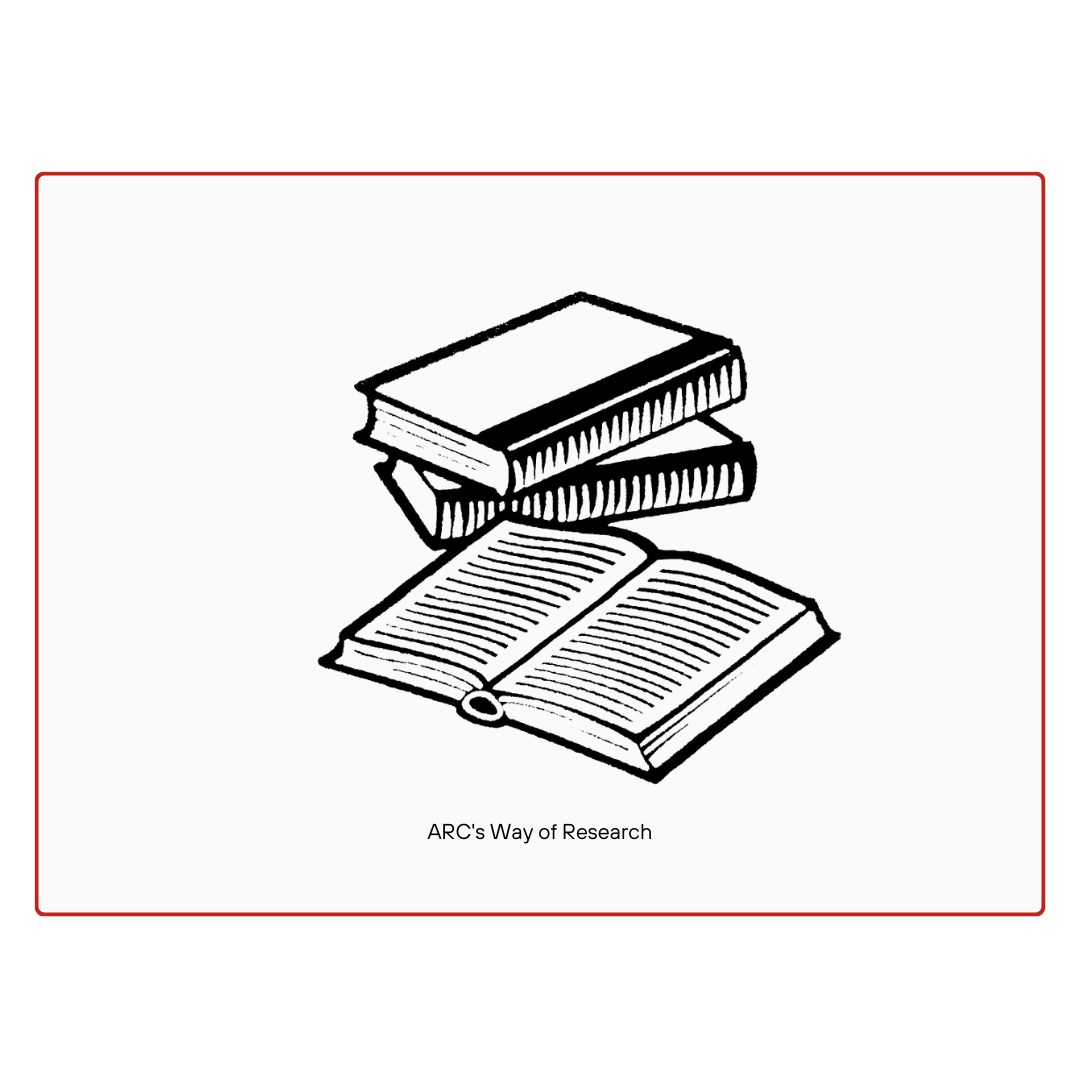
Research Manual
(ARC's Way of Research)
Research is an omnipresent function at ARC, it is required at different points by different functions. The research manual is a way to access shared knowledge of holding the objective lens in conversations, meaning making of information and a lot more.
and also ran a Research Based OD project
The Sense of Being Respected project

(Client Project with the World's Largest Tire manufacturer)
Organisational development starts with building awareness in the system. That is what we did in the project 'Sense of Being Respected' (SOBR).
Respect and Fairness being one of the essential experience for the client organisation, when this was challenged by the scores received in an internal assessment, led to ARC stepping in.
The Playground Evolved
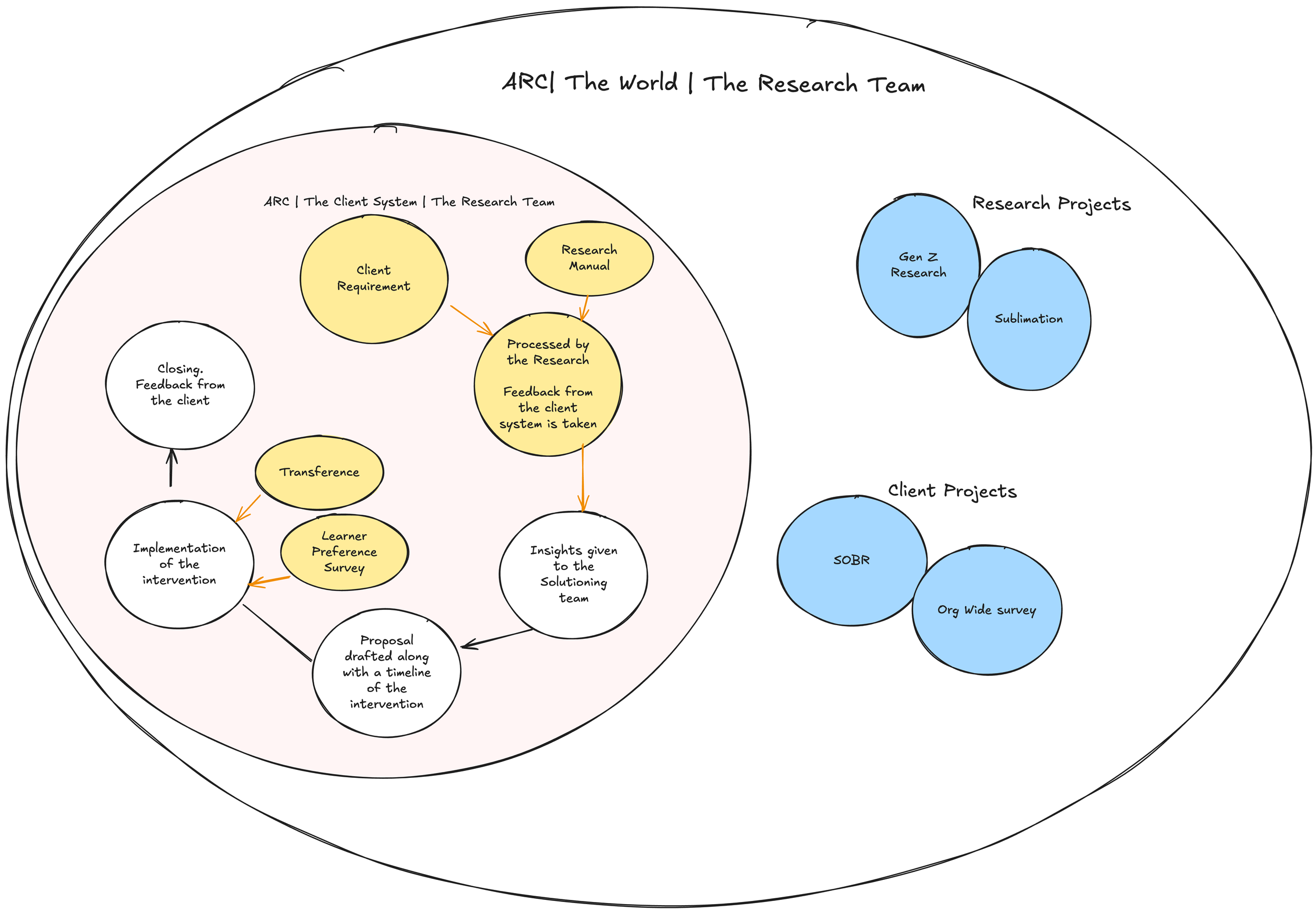
The landscape of the Research function evolved as the firm grew. In the near future, the latest 'and also' is the creation of psychometric assessments for the world. Sharing what's brewing in the kitchen.
People don’t leave organisations; they often leave the culture of the organisation. Values guide how an organisation functions and set the tone for what is okay and not okay. But individuals come with their own value system.
This is an assessment that aims to understand what matters to the individual. Clarifying, what their values are "oriented" towards? What does their inner compass tell them to do?
And then help organisations make decisions on whether this individual's compass aligns with the organisation's compass
Value Adherence Assessment
“What Does Respect Mean To You?”: An Exploration of Non-Negotiable Ethics Across Generations
Once carries their values and beliefs in every situation they go. Though value and belief may change or get influenced there is something that is at the core of the person and doesn't get shaken off, no matter what.
Through this study, the research team is trying to tap into non-negotiables that people carry in every aspect of their lives (both personal and professional). Through this research project we have been able to identify different ethics that exist in domains of personal and professional life.
An assessment created at the end of this would help organisations and individuals to explore the non-negotiables and align it with an organisation. It would help to explore where possibly a conflict or dissociation may emerge.
Leadership Patterns
Leaders build culture, culture builds organisations. Till now, assessments captured one's leadership style in isolation. This assessment taps into the pattern of leadership in an organisation and the impact of it.
This informs the organisation on the kind of leaders they are creating and what more they need to do to reach their goal.
And also are forming an arm of Applied BeSci to bring in humaneness back into technology.
Minimum Intervention and Maximum impact.

The tip of the iceberg
What you see above are simply things that are visible to the eye. But there are hours of ideation, brainstorming, reading research papers, processing data, staring at excel sheets, tinkering with each small question, exploring that goes behind in what we present to the world. One needs to passionate, nerdy and maybe even a little crazy to do something like that.
If you are open enough to explore, here are a few ways for you to engage with us
Be part of our research studies.
Collaborate on a research project