Why Your Best People Stop Thinking.
Last 4 ICC events for the Indian Cricket Team:
Won the 2026 T20 World Cup
Won the 2025 Champions Trophy
Won the 2024 T20 World Cup
Lost the finals of the 2023 World Cup
Reports indicate India lost only 2 matches out of their last 29 in ICC events. This signals a domination in white-ball cricket by India. Similar to the golden era of Australia from 1999- 2007, where teams played with fear against them.
In the most recent T20 World Cup win, a common narrative emerged from the players. "...the credit for the victory should not only go to the players but also to the coach and team management". In multiple interviews, players spoke highly of the team culture and the backing they received from the coaching staff and captain. To a keen cricket fan, this spirit was evident throughout the tournament and now has been for a while.
This was a conscious effort by Gambhir and captain Suryakumar Yadav. They inculcated a "team-first" mindset where personal milestones were deprioritised.
OD Approach: Now, if I had said this in front of an OD consultant, they would've prompted me to break down my interpretation of the situation by asking me what I saw or heard that brought me to this conclusion. Because behaviours are visible, while interpretations are the meaning we've made of them.
So, a "team-first" approach can be demonstrated in multiple ways; one that was visible to the audience was the practice of 'Rotational Leadership'. Team huddles were led by various players, Pandya, Bumrah, Axar Patel and even Arshdeep Singh.
Otherwise, usually, led by the coach or captain.
While this can pass as a minor observation, it was actually a conscious effort by the team to create 'thinking players'.
Who are 'Thinking Players'?
The microcosm of a champion team is an individual high on learning. Yes, learning.
When each player is exposed to the best of the facilities, coaches, dieticians, grounds, gyms, analysts, psychologists and a lot more. Elasticity of learning becomes the differentiator.
And Paddy Upton, one of the pioneers of sports psychology in International cricket, breaks this word down further.
Quick fact: Upton, the mental conditioning coach, was part of the coaching staff along with Gary Kirsten that won India the ODI World Cup in 2011 after 28 years.
Upton has adapted the popular Kolb's cycle for the sports world. Which is otherwise used by L&D folks, HR professionals, educators and consultants.
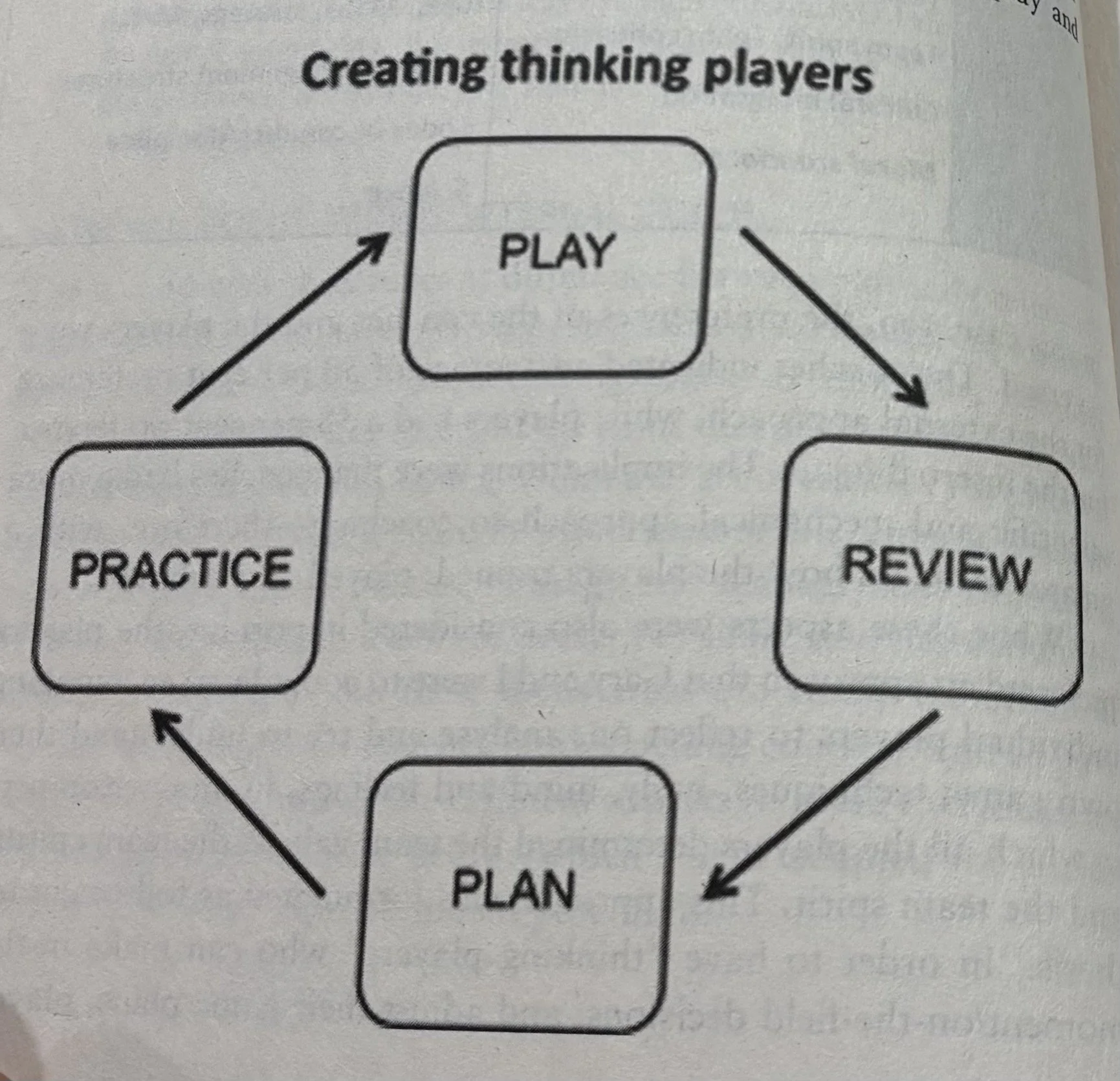
Kolb's Cycle adapted by Upton
Play → Review → Plan → Practice.
Mentioned in Upton's thesis on 'In order to have "thinking players" who can make in the moment/ on the field decisions and adjust their game plans, players, would have to be actively involved in the reflection, analysis and planning and not have it simply imposed on them by the coach.'
The graphic above shows how players learn.
Play: The first step comes from playing the game.
Review: Later, depending on the level of sport, through video and stats, retrospection happens. What worked, what didn't, including thoughts, feelings and the effect of it on performance at key moments of the game. Usually done by the coach based on their observation and other data points.
Plan: Then the focus moves to planning for the next game, equipped with lessons from the past game plus a certain knowledge of the opponents, expected conditions and whatever else might be relevant for strategising. A plan is chalked out.
Practice: The next step is to take these plans into the training field and practice according to them. Followed by the execution of it in the next game.
The more times this cycle is repeated, the more 'experience' they get, the more they learn. This happens best when a player is involved in all 4 stages of the cycle. That's when 'Thinking Players' are created.
And the Indian Cricket Team practising Rotational Leadership in team huddles is a small example of that. Of involving players in the 'plan' and 'review' stages.
A Disabler to Thinking Players: 'Instructional Coaches'
On the flip side, there are teams run by coaches that follow a different philosophy. Especially in franchise cricket, where the stakes are high. Coaches, support staff and players are paid big bucks to perform. To win.
A coach gets compelled to prove their worth by over-involvement in Plan and Review while the players Practice and Play. It's in those moments when a coach gets to share their expertise as the knowledge authority in the room. But then, 15 minutes into the de-brief, you find players texting/scrolling under the table, bored faces and half-unconvincing nods. The same pattern gets repeated in a pre-match routine.
The players execute while the coaches are the minds behind it.
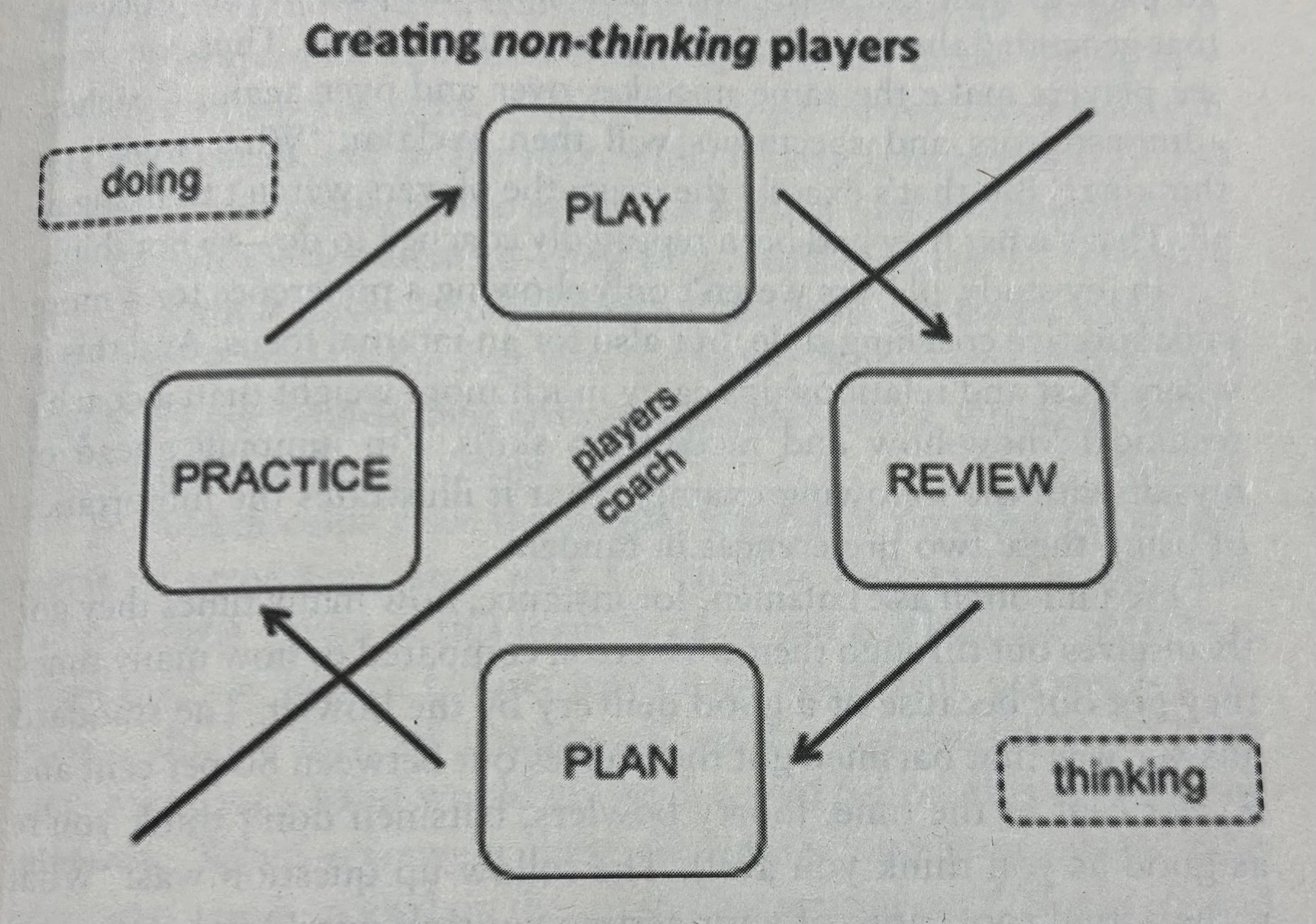
Kolb’s cycle when broken.
The consequence of it? Once these players are put in pressure situations, they resort to their default way of playing; the strategy goes out for a toss, since they were never part of the 'thinking' process. That was done by the coach.
And the cycle of learning never completes. A psychological crutch gets places with the coaches.
The Workplace has its own Instructional Coaches
The advent of knowledge workers marked a shift from manual labour to intellectual work, where people 'think' for a living.
But the cycle of Play→ Review → Plan → Practice still breaks in a subtle way.
Yes, the roles of strategy and planning get assigned to certain people because of their skills, but when the people executing are rarely in the room where the thinking happens, the cycle breaks before it can complete.
There's a difference between a manager who plans with their team and one who plans for them.
The first builds thinking players.
The second builds executors.
This is where the learning cycle stalls.
With time, the systemic impact of it creeps in slowly. It affects the leadership pipeline. Every time a leader jumps in to provide a solution too quickly, they steal the opportunity of 'thinking'.
With AI in the picture, the risk of a permanent psychological crutch becomes even more evident.
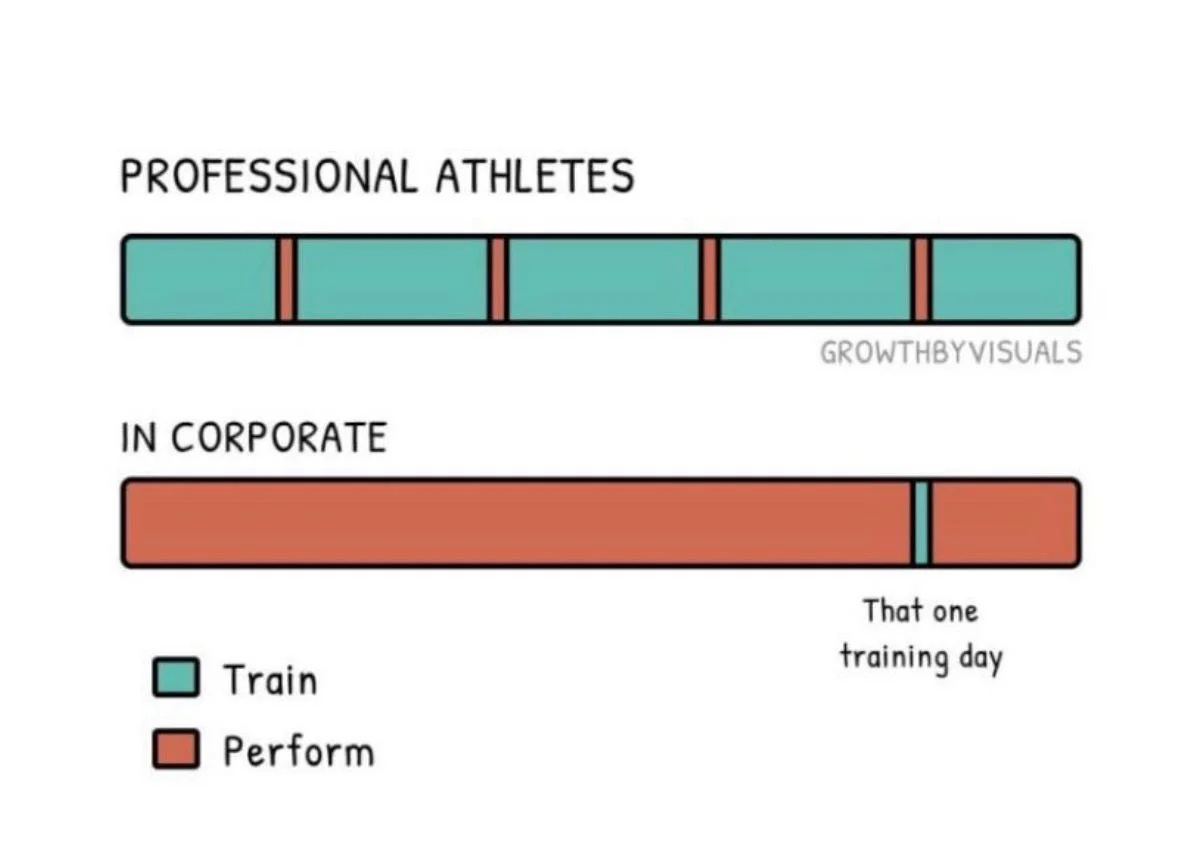
So in the context of workplaces, practice in its truest sense is being given a problem you haven't solved before, with actual stakes, and no manager in the room to bail you out.
So I'll leave you with a question that's harder than it sounds:
When did you last let someone on your team think without a safety net?
PS: